

Interlock does not fail all at once. It usually starts small. One corner drops. One paver moves. One edge opens. A walkway begins to dip where people step every day. A driveway forms two tired little tire paths. The patio starts holding water in a low spot. Nobody throws a parade. The surface just gets worse.
At E&A Renovators, we handle interlock and landscaping work across Ottawa. Repair work often starts with a visible problem, but the real cause usually sits underneath. The surface shows the complaint. The base, grade, edge support, or drainage usually wrote it.
Interlock repair in Ottawa can include:
- lifting and resetting sunken pavers
- fixing loose or spreading edges
- correcting low spots
- improving drainage around problem areas
- repairing walkway dips
- addressing driveway tire-path settlement
- reviewing steps and landings that have shifted
- cleaning up transitions into sod, riverstones, or surrounding hardscape
Some repair jobs stay small. Fine. A few shifted stones near an edge may not require a full rebuild. Other jobs only look small from above. A sunken front landing, a driveway with deep tire paths, or a walkway that keeps collecting water may point to base trouble. The ground has a long memory — and it enjoys bringing up old mistakes.
We handle this kind of work through our Ottawa interlock and landscaping services. That service list includes driveways, walkways, patios, steps and landings, retaining walls, landscaping, interlock, concrete slabs, riverstones, and sod. Repair work often crosses those categories because outdoor surfaces touch each other. A driveway meets a walkway. A walkway meets a front step. A patio meets sod. Water moves through all of it without asking for department names.
Why interlock starts sinking or shifting
Interlock sinks because something under it stopped doing its job. That is usually the plain answer. The pavers get blamed because everyone can see them. The base hides below, wearing a cheap disguise.
Several things can cause movement:
| Cause | What happens |
|---|---|
| Weak base preparation | The surface loses support and settles |
| Poor compaction | Pavers shift after traffic and weather |
| Water movement | The base softens or washes out in weak areas |
| Freeze-thaw cycles | Ottawa weather pushes and pulls at weak spots |
| Missing or weak edge restraints | The surface spreads at the sides |
| Heavy vehicle use | Driveway tire paths sink under repeated load |
| Poor grading | Water sits where it should move away |
Ottawa gives interlock a fair test, which is to say an unfair one. Snow piles up. Salt grinds into the joints. Water gets into low spots. Freeze-thaw cycles pry at weak work. Driveways carry cars. Walkways carry foot traffic. Front entrances carry everyone, every day, usually with wet boots and no patience.
A strong interlock surface needs more than good-looking pavers. It needs excavation, base preparation, grading, edge restraints, joint sanding, and compaction. We covered that process in more detail in our guide to hiring an interlock contractor in Ottawa. The same rules apply to repair work. We still need to know what the surface is doing and why.
The tricky part is that poor prep can hide for a while. A surface may look fine after installation. Then the base settles. The edges open. Water starts sitting in one place. The pavers move because the support underneath has changed. A repair should address that cause, not just make the surface look calm for a season.
This is where a site review matters. A repair that ignores water will meet the same water again. A repair that ignores edge restraint will watch the edge move again. A repair that ignores base failure may only reset the problem with cleaner lines.
The surface is the symptom. The ground writes the diagnosis.
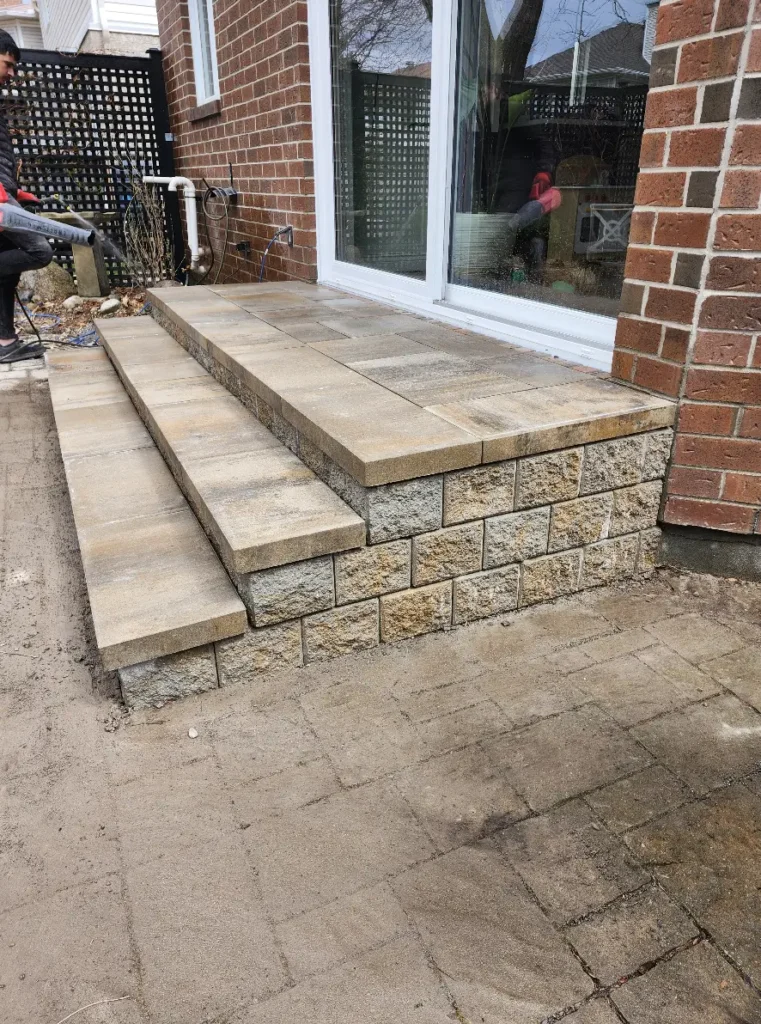
Common interlock repair jobs in Ottawa
Most repair calls begin with one visible problem. A homeowner sees a dip, a gap, a loose edge, or a low spot. That gives us a starting point. It does not always give us the whole story.
Common interlock repair jobs in Ottawa include:
| Repair area | Common problem |
|---|---|
| Driveways | Sinking tire paths, spreading edges, settlement near garage |
| Walkways | Dips, uneven footing, loose borders, poor tie-ins |
| Front entrances | Landing movement, step gaps, water near the door |
| Patios | Low spots, pooling water, edge movement |
| Steps and landings | Uneven rise, shifted support, poor transition to walkway |
| Borders | Loose edge stones, spreading, weak restraint |
| Yard transitions | Muddy sod edges, riverstone movement, poor surface tie-ins |
Driveway repair often involves load problems. Vehicles follow the same lines, and weak support shows up fast in those tire paths. We wrote more about that surface in our guide to interlock driveway installation in Ottawa. A driveway repair needs to respect the weight that caused the problem in the first place.
Walkway repair often starts with uneven footing. A front walk may dip near the steps, shift near the driveway, or open along the edge. That kind of movement matters because people use walkways without thinking. A bad walkway makes them think. Nobody wants that from a path.
Front entrance repair gets more sensitive. The walkway, steps, and landing all work together. If one part shifts, the entrance feels wrong. We explain that system in our post on front entrance interlock contractor work in Ottawa and in our guide to walkway and front entrance interlock in Ottawa.
Patio repair usually involves low spots, edges, and drainage. A patio that holds water may need more than a few reset stones. It may need a look at the grade. Water is patient. It will find the same spot again if the repair gives it the chance.
Some repair jobs stay neat and limited. Others open the door to a larger fix. The difference comes from the cause.
Repair or rebuild: how we read the site
The first question is not “Can this be repaired?” The first question is “Why did this fail?”
That answer decides the path. A few loose pavers near an edge may be repairable. A sunken driveway with repeated tire-path dips may point to weak base support. A front landing that holds water may need grading work. A walkway that has shifted along its full length may need more than a surface reset.
Here is the rough way to think about it:
| Site condition | Likely direction |
|---|---|
| One small loose area | Local repair may work |
| Minor edge movement | Edge repair may work if the base is stable |
| Repeated sinking | Base issue may need deeper work |
| Pooling water | Grading or drainage must be reviewed |
| Full surface movement | Rebuild may make more sense |
| Step or landing movement | Entrance system should be reviewed |
| Driveway tire-path settlement | Load support needs a closer look |
A repair should not pretend the cause does not exist. That is how homeowners pay twice. The surface gets reset, the same water returns, and the same low spot forms again. The pavers do not care. They go wherever the base allows them to go.
We look at the full area around the problem. For a walkway, we check the edge, the grade, the step connection, and the nearby driveway or lawn. For a driveway, we check tire paths, garage transition, street edge, slope, and border support. For steps and landings, we check height, movement, base support, and water near the entrance.
This is why repair work often links back to the larger service category. Interlock does not live alone. It touches landscaping, sod, riverstones, retaining edges, concrete slabs, driveways, walkways, patios, steps, and landings. Those all sit inside our Ottawa interlock and landscaping services.
A rebuild makes sense when the original support has failed too widely. No one wants to hear that. Fair enough. But a small repair over a large base problem can become a tidy little lie. It looks good for a while. Then Ottawa weather reads the fine print.
We prefer to read the site first and let the ground ruin the fantasy early.
Interlock driveway repairs in Ottawa
Driveways are hard on interlock. They put repeated weight in the same places. Tires follow the same paths every day. Snow sits on the surface. Salt gets worked into the joints. Water runs toward the easiest low spot. The driveway does not get a break. It gets a car.
Common driveway repair problems include:
- sinking tire paths
- pavers moving near the garage
- edge spreading along the lawn
- loose stones near the street
- water pooling in low spots
- gaps between pavers
- settlement where the driveway meets a walkway
A driveway repair needs to focus on support. Resetting pavers without checking the base can leave the same problem waiting under the surface. Tire-path sinking often points to load support issues. Edge movement may point to weak restraints. Water near the garage may point to grading trouble.
We explain new driveway planning in our post on interlock driveway installation in Ottawa. Repair work uses the same logic in reverse. We look at what failed, then work back to the cause.
A driveway often connects to other front-yard surfaces. It may meet the walkway. It may run beside sod. It may connect near the steps or landing. A driveway repair that ignores these connections can leave a rough transition behind. That rough transition may become the next problem.
Here is what we check during driveway repair review:
| Driveway area | What we look for |
|---|---|
| Tire paths | Load settlement and repeated sinking |
| Garage edge | Height, water movement, surface transition |
| Street edge | Loose pavers, spreading, weak support |
| Side edges | Lawn pressure, missing restraint, soft edges |
| Walkway connection | Level change, gaps, trip points |
| Drainage path | Low spots and water direction |
Not every driveway problem means a full replacement. Some areas can be lifted and reset. Some edges can be tightened. Some low spots can be corrected. The decision depends on how far the failure goes.
The driveway tells the story in tire marks, dips, gaps, and edges. We just translate.
Walkway, front entrance, steps, and landing repairs
Walkways and front entrances fail in ways people feel before they study. A foot catches slightly. The step feels uneven. The landing seems to slope. Water sits near the door. The entrance starts acting like a small daily insult.
These repair jobs often involve connected surfaces. The walkway meets the steps. The steps meet the landing. The landing meets the door. The grade touches all of it. One bad connection can make the whole entrance feel off.
Common front entrance repair issues include:
| Area | Common issue |
|---|---|
| Walkway | Sinking, uneven footing, loose border |
| Steps | Shifted rise, gaps, unstable edge |
| Landing | Water pooling, surface movement, small usable space |
| Driveway tie-in | Uneven connection between car area and walkway |
| Lawn edge | Muddy transition or weak border |
| Riverstone edge | Loose or poorly defined finishing area |
We wrote more about this in our guide to walkway and front entrance interlock in Ottawa. That post looks at the entrance as a working path. We also covered step-specific issues in interlock steps and landings in Ottawa.
A front entrance repair needs special attention because the area sits close to the house. Water near the door matters. A bad step height matters. A landing that moves matters. These are not just visual issues. They affect daily use.
Sometimes the repair can stay small. A short walkway section may need lifting. A border may need resetting. A landing edge may need attention. Other times, the entrance system has moved enough that the full area needs a larger plan.
We also wrote a contractor-focused version in front entrance interlock contractor in Ottawa. That article explains how the walkway, steps, landing, and grade should work as one piece.
For homeowners, the basic check is simple:
- Does the walkway feel uneven?
- Does water sit near the door?
- Do the steps feel different from one side to the other?
- Does the landing feel too small or tilted?
- Are the edges spreading?
- Has the same area been repaired before?
A front entrance should not feel like a negotiation with the ground. It should just get people to the door.
What homeowners should check before contacting E&A Renovators
A repair request goes better with clear details. You do not need to diagnose the whole problem. That is our work. You just need to show us what you see.
Start with photos. Take wide shots first. Then take close photos of the problem areas. Show the edge. Show the low spot. Show where water sits. Show the connection to the driveway, steps, landing, lawn, or patio. The more context we see, the less guessing the first conversation needs.
Before contacting us, check these points:
| What to check | Why it helps |
|---|---|
| Where the surface is sinking | Shows the main failure area |
| Whether water pools | Points to grading or drainage concerns |
| Whether edges are spreading | Points to restraint or support issues |
| Whether steps feel uneven | Points to entrance movement |
| Whether the issue repeats | Suggests a deeper cause |
| What surface connects nearby | Helps us read the full area |
| Rough size of the problem | Helps frame the scope |
A useful message can stay short:
- “The driveway tire paths are sinking.”
- “The walkway dips near the steps.”
- “The patio holds water in one corner.”
- “The edge is spreading along the lawn.”
- “The front landing has shifted.”
- “The same area has been repaired before.”
Those details help us start the right conversation.
You can contact us through the E&A Renovators contact page. Our site lists Ottawa, Ontario as our service area. You can also call +1 613-979-7771 or email info@earenovators.ca.
If you want to look through our work first, start with the Ottawa interlock projects page. You can also view local project pages such as Findlay Creek and Convent Glen. For company background, visit about E&A Renovators.
A repair starts with what you can see. The work starts with what caused it.
FAQs about interlock repair in Ottawa
Why is my interlock sinking?
Interlock usually sinks because the base has lost support, water has moved through the area, compaction was weak, or the surface takes more load than the base can handle. Driveways often show this in tire paths.
Can sinking interlock be repaired?
Sometimes. If the problem is local and the surrounding base is stable, repair may work. If the base has failed across a wider area, a rebuild may make more sense.
Do I need a full interlock rebuild?
Not always. We look at the surface, base signs, drainage, edge support, and connected areas before deciding whether repair or rebuild fits the site.
Can you repair interlock driveway tire paths?
Yes, driveway tire-path issues can be reviewed and repaired depending on the cause. Repeated sinking may point to load support or base problems. Our post on interlock driveway installation in Ottawa explains why driveway prep matters.
Why are my pavers spreading at the edge?
Spreading edges often point to weak or missing edge restraints, soft surrounding ground, or surface movement. The edge needs to hold the field in place.
Can you repair front entrance interlock?
Yes. Front entrance repair may involve walkways, steps, landings, grading, edge restraints, or surface resetting. We explain this area in our guide to front entrance interlock contractor work in Ottawa.
Does interlock repair include patios and walkways?
Yes. Repair work can include patios, walkways, driveways, steps, landings, and related edge areas. Our Ottawa services page lists the full service range.
How do I request an interlock repair quote in Ottawa?
Use the E&A Renovators contact page, call +1 613-979-7771, or email info@earenovators.ca.